Unleashing 5MP Stereo Vision: Why High-Resolution 3D Sensing Requires Advanced Calibration

Unleashing 5MP Stereo Vision: Why High-Resolution 3D Sensing Requires Advanced Calibration
At NODAR, we are pushing the boundaries of what’s possible in robotic perception. Our latest research, recently published on arXiv, explores a critical shift in the industry: the transition to high-resolution, 5-megapixel (5MP+) stereo vision systems.
While more pixels promise longer range and denser point clouds, our study reveals a fundamental truth—hardware alone isn't enough. To unlock the full potential of 5MP sensors, you need a new level of calibration accuracy.
The 5MP Advantage: Range and Precision
High-angular-resolution sensors are essential for next-generation robotics. Our research confirms a new scaling law: point cloud quality (range resolution) scales as the square-root of the number of camera pixels.
By increasing resolution from 1MP to 5MP, we've demonstrated:
Long-Range Detection: A 5.4x increase in resolution improves the sensor's range by a factor of 2.246.
Micro-Scale Precision: At close range, 5MP systems provide the sub-millimeter precision required for delicate robotic manipulation and inspection.
Metrically Accurate Reconstructions: Unlike monocular depth networks that struggle with scale, our stereo triangulation provides direct, reliable 3D measurements.
The Calibration Gap
The transition to high resolution introduces a "performance bottleneck". Conventional static calibration—the kind done once at the factory—is no longer sufficient for 5MP setups.
In real-world environments, factors like engine vibration or road shocks cause camera parameters to change frame-by-frame. For instance, a 1-meter baseline camera is 100 times more sensitive to vibrations than a 10-cm baseline camera. Without dynamic, online calibration, the theoretical quality of a 5MP sensor is lost to residual errors.
NODAR’s Solution: Hammerhead & Ground Truth
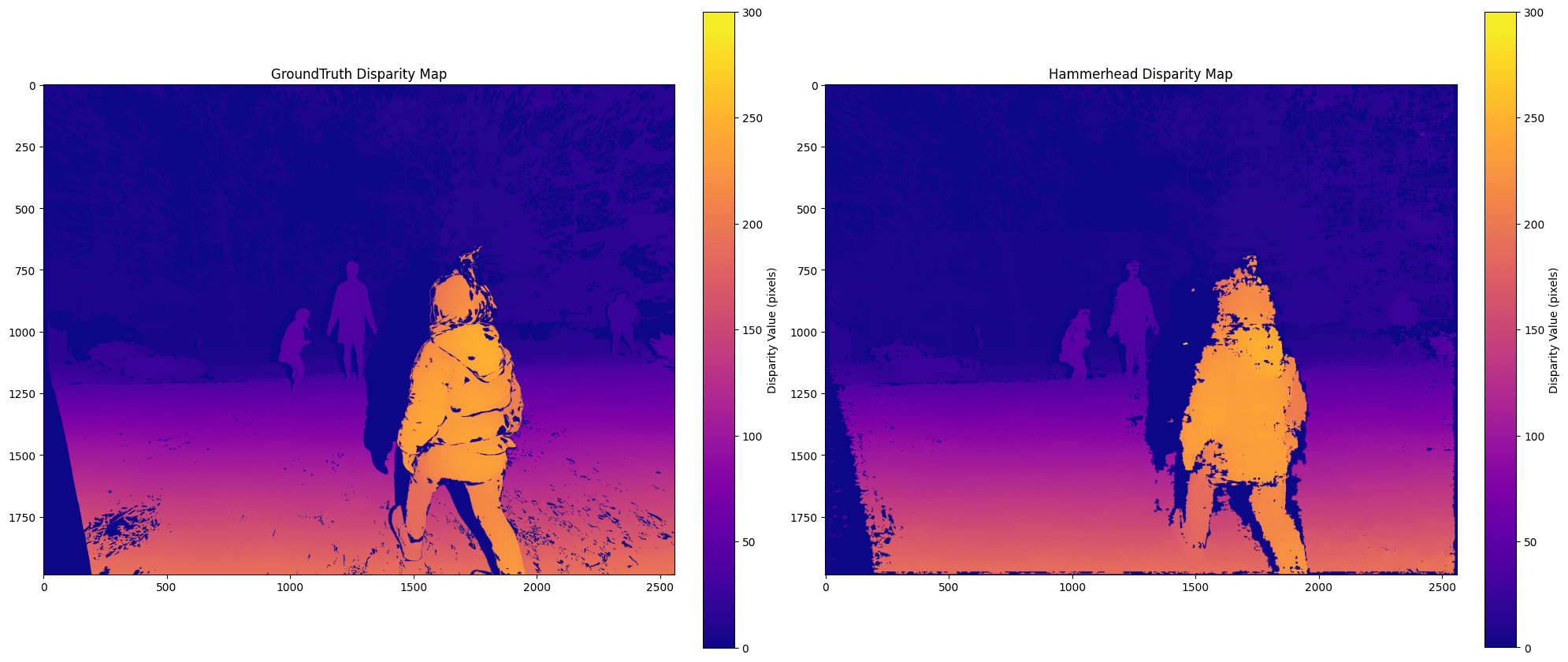
Our study highlights two distinct stereo matching approaches developed at NODAR to solve these challenges:
Algorithm | Primary Objective | Best Use Case |
Hammerhead | High-throughput, low-latency processing of full 5MP images. | On-board, real-time autonomous robotic systems. |
Ground Truth | Maximum disparity map accuracy via computationally intensive matching. | Offline training, validation, and establishing references. |
Proving the Performance
We validated our real-time Hammerhead algorithm by comparing it against our Ground Truth results. The findings were clear: our advanced, frame-to-frame auto-calibration allows a wide-angle camera with only a 15-cm baseline to effectively perceive objects at ranges exceeding 20 meters—a feat previously thought impossible for such a compact setup.
Conclusion: The Future is High-Res
The industry is moving toward outdoor robotics, where high dynamic range (HDR) and high resolution are non-negotiable. At NODAR, we’ve proven that by combining 5MP imagery with our proprietary online calibration, we can deliver sub-meter depth error at distances where traditional systems fail.
Want to dive deeper into the data?
Check out our full paper: https://arxiv.org/abs/2601.22445
Or explore our open-source datasets and Google Colab notebooks to see the results for yourself.