NODAR HDK hardware
NODAR HDK hardware
NODAR HDK hardware

[ NODAR HDK ]

Hammerhead
Development Kit
HDK 2.0

Develop autonomous and 3D monitoring applications using Hammerhead Development Kit (HDK).

System Overview

NODAR’s Hammerhead Development Kit (HDK) provides perception engineers access to Hammerhead's breakthrough ultra-wide baseline stereo 3D vision system.

Supporting long-range 3D perception (up to >1,000m) with millions of pixels as well as providing cm-level depth precision, NODAR Hammerhead can be used in a wide range of applications ranging from automotive ADAS to fully self-driving commercial vehicles, agriculture, UAVs, rail, construction vehicles, indoor robotics, and more.

Designed to enable engineers to quickly and easily evaluate NODAR technology, the HDK produces high-resolution pointclouds out of the box and can be set up within minutes. In addition, the HDK comes with NODAR GridDetect, a feature that enables detection of objects and provides their size, position, and velocity.

The HDK ships with everything needed to evaluate the Hammerhead system, including visualization software, API access to capture realtime data, data logging capabilities, and all necessary hardware (cameras, lenses, mount, compute module, cables).

Applications

Trucks

Ultra long-range, small object detection - detect a 25cm object at 305m to allow for time to stop or avoid.

Passenger Cars

Precise long-range object detection for L3 and above.

Air Mobility

Long-range detection in any direction improves safety.

Heavy Equipment

Resilience to dust and high-vibration, and best-in-class performance in low visibility.

Ferry

Robustness with moving horizon and ultra-fine precision at short distances for docking.

Rail

1000m+ range obstruction detection for collision avoidance and mapping.

Last Mile Delivery

Low-cost, flexible camera mounting, low compute and fine precision - perfect for mobile robots.

Robotaxi

Sensor fusion with lidar provides redundancy while enabling safe highway driving.

Agriculture

Resilience to dust and vibration for autonomous operation, and precision for spout alignment.

Hammerhead Benefits

NODAR Hammerhead delivers unparalleled accuracy and reliability, even in challenging environments like dust, low light, rain, and fog. Leveraging patented auto-calibration technology and off-the-shelf cameras, the system provides consistent, high-resolution depth data with minimal setup, ensuring rugged, cost-effective performance for variety of applications.

Accuracy and Range

High accuracy by computing the true depth of every pixel based on stereoscopic parallax rather than crudely interpolating from known objects.

Low Visibility Performance

High performance in difficult conditions such as high-dust, low-light, rain, fog, and direct sunlight.

Consistency of Results

Patented auto-calibration technology actively compensates for camera perturbations due to wind, road shock, vibration, and temperature.

Ruggedness and Reliability

High longer-term reliability due to no moving parts. Robust against manufacturing variations and wear-and-tear, tolerating angle changes up to +/- 3 degrees.

Easy Installation

Easy installation and integration, mounted via tripod mounting holes. Multiple compute and software integration options.

Value

Hammerhead leverages off-the-shelf cameras for minimal hardware cost requirements. Processing for stereo calibration can be performed either on a dedicated ECU or shared with an existing ECU.

HDK 2.0 Hardware Reference

Camera support

Ships with Sony IMX490 5MP (also supported: 8MP, 12MP, LWIR, Global Shutter)

Lenses

6mm/70° FOV or 16mm/30° FOV ¹, both f/1.6 and f/2

Processor

NVIDIA Orin Jetson ²

Specifications

Calibration

Continuous (every frame)

Baseline

Tested up to 3m

Frame rate

Up to 30 FPS

Max capacity

50 million pixels/second

depth precision

0.2-0.4% @ 100m

Maximum range

Tested to 1,000m

Precision

Able to detect 10cm object at 150m

Camera alignment tolerance

+/-3°

Stereo matching algorithm

Deterministic signal processing algorithm

Vibration tolerance

0.1° per frame

1. Other lenses and cameras can be supported

2. Software-only technology enables porting to Intel+GPU or other processors

Frequently Asked Questions

How is NODAR different?

NODAR’s Hammerhead technology enables unparalleled detection of small objects at large distances by supporting large-baseline mounts (0.5-3m or larger) with independently mounted (no connecting bar), high-resolution cameras. This is accomplished with patented algorithms that automatically calibrate in real-time to compensate for misalignments that arise from larger baselines.

Does Hammerhead work in low visibility?

With recent improvements in camera sensors, Hammerhead is effective in low-light conditions, such as city streets or headlight-illuminated scenes at night. We have also tested well against LiDAR in dusty, rainy, and foggy conditions, and Hammerhead technology can also be adapted to work with infrared or thermal cameras.

What is included in Hammerhead’s HDK 2.0?

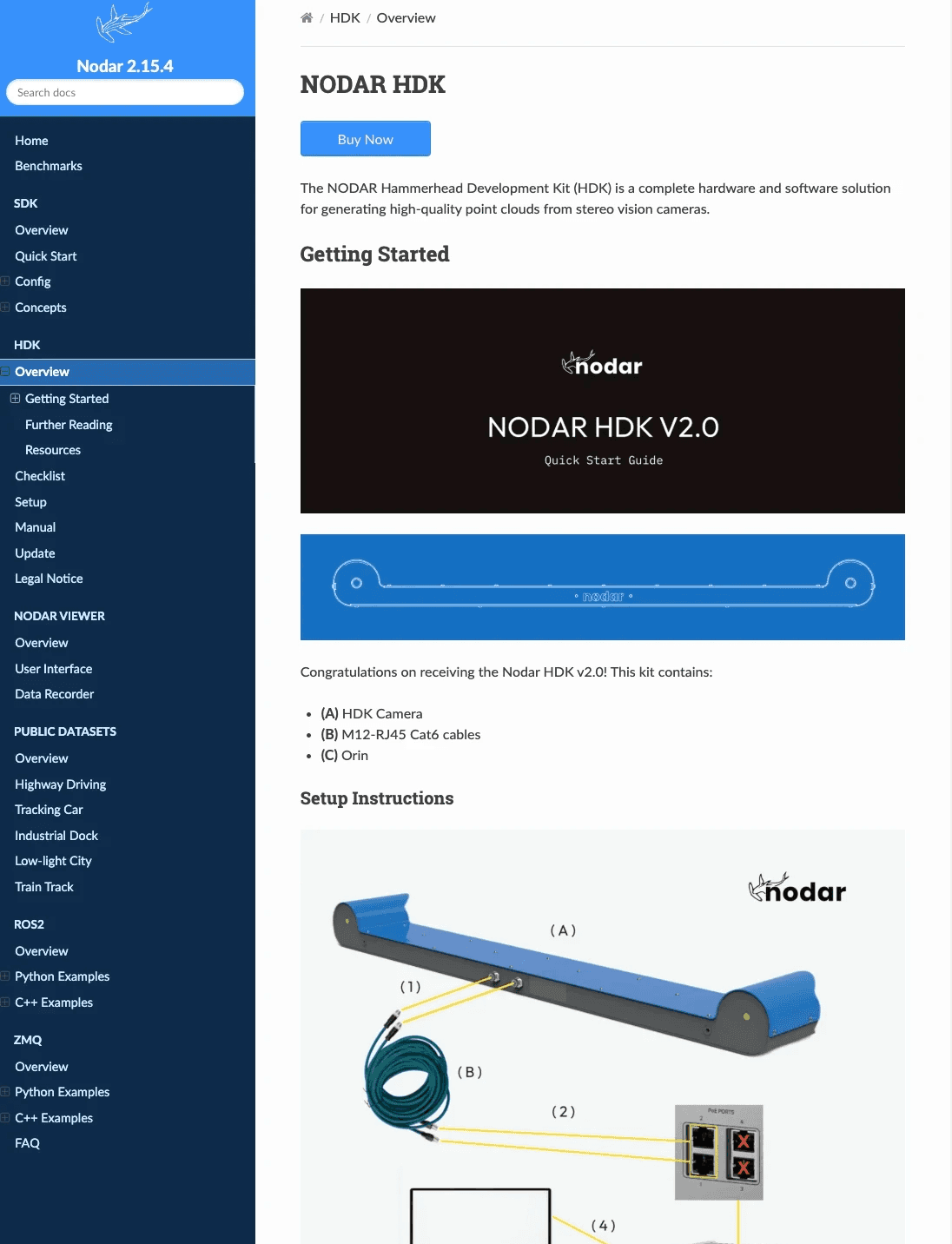
The HDK includes both hardware and software to evaluate and integrate with Hammerhead. The hardware is comprised of an Electronic Control Unit (ECU), 2 cameras, and all necessary connection cables. The software includes applications for demoing Hammerhead, collecting data, calibrating the initial camera setup, and an integration API.

How long does the installation take?

The HDK is designed to work immediately out of the box. You would only need to connect a power source and a display to see Hammerhead technology in action.

How does calibration work?

Stereo cameras are known to lose alignment due to vehicle vibration, temperature fluctuations, and long-term, small component movements. Using unique patented technology, Hammerhead automatically calibrates on every video frame to compensate for these alignment variations.

What mounting configurations are supported for HDK 2.0?

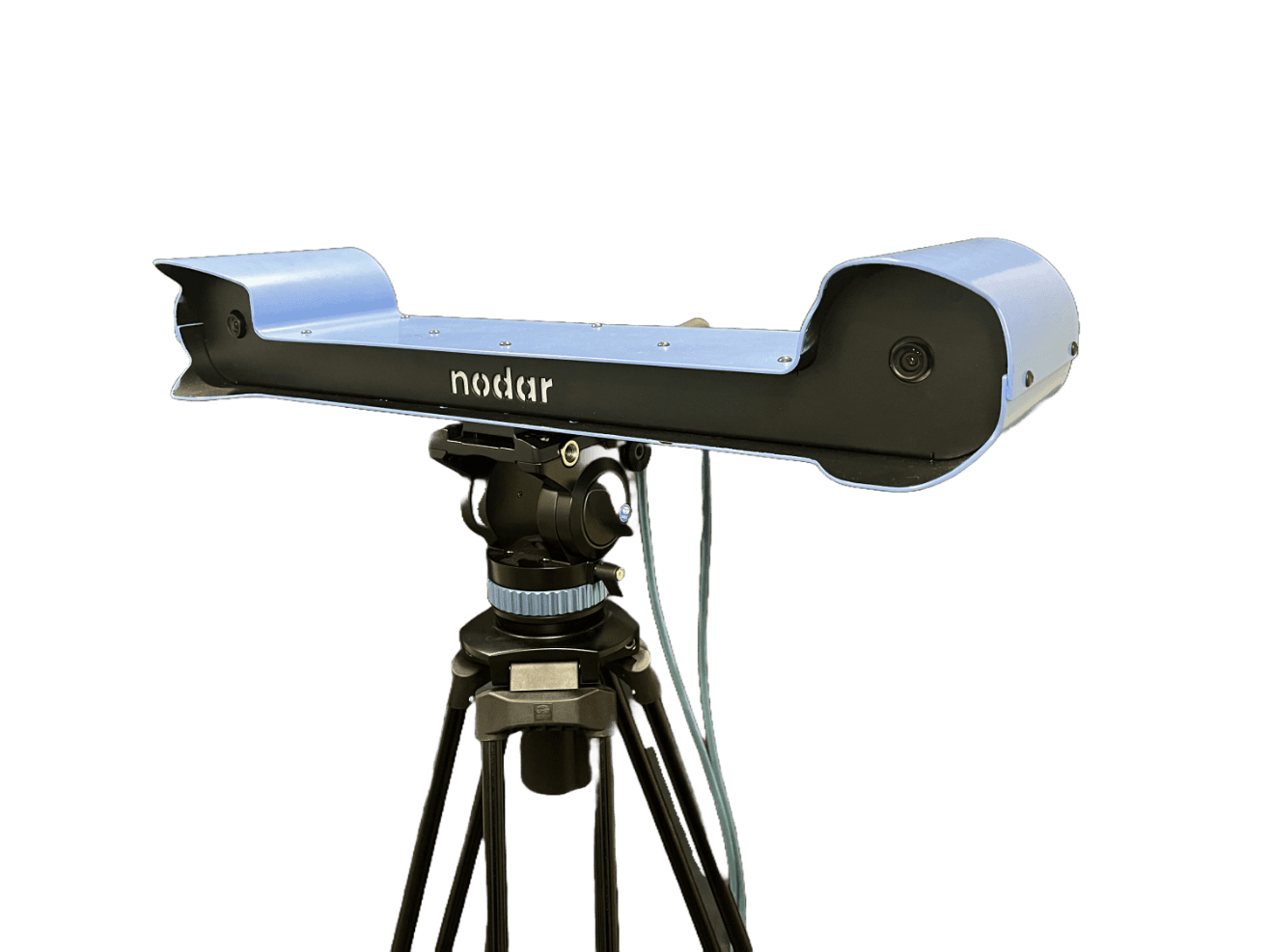
The entire HDK camera assembly can be mounted to a vehicle or structure via tripod mounting holes. Even though the cameras in the HDK are mounted at a fixed baseline, production versions of Hammerhead can be shipped with custom baselines and mounts depending on specific application requirements.

What is the HDK's camera resolution?

As shipped with the HDK, a 5-megapixel resolution is supported. If desired, additional resolutions can also be supported with different camera hardware.

What computing platforms are supported by the SDK?

The SDK is provided as prebuilt .deb packages for the following configurations:

  • Ubuntu 20.04
    CUDA 11.4 (AMD64, ARM64)
    CUDA 12.0 (AMD64)

  • Ubuntu 22.04
    CUDA 12.1, 12.2, 12.3, 12.6, 13.0 (AMD64)
    CUDA 12.2, 12.6 (ARM64)

  • Ubuntu 24.04
    CUDA 12.9, 13.0 (AMD64)

Typical performance (5.4 MP images)

  • Jetson Orin AGX: ~5–10 fps

  • NVIDIA RTX A5500 (Laptop): ~15–20 fps

  • NVIDIA GeForce RTX 4090 (Desktop): ~20–25 fps

Performance varies based on configuration, including image resolution (1–8 MP), bit depth (8-bit vs. 16-bit), and whether optional modules such as GridDetect are enabled.

As a general guideline:

  • Modern laptops typically achieve ~15–20 fps

  • Desktop systems with high-end GPUs typically achieve ~20–30 fps

What are the minimum recommended compute specs for the SDK?

We currently require an NVIDIA GPU. Our binaries rely on Cuda and target Ubuntu 20.04, 22.04, and 24.04 for ARM and AMD64 (Intel and AMD Cpus). For a complete list of supported systems, please visit https://docs.nodarsensor.net/index.html#supported-systems

What is Hammerhead's maximum supported distance?

Hammerhead can detect objects at large distances. With the 16mm (30° field of view) lens option, humans are clearly detectable at 500m. Even with the wider 7mm (65° field-of-view) lens option, humans are clearly detectable at 200m.

How is software integration done for HDK 2.0?

The HDK ships with ROS2 and C++ APIs, along with thorough documentation at https://github.com/nodarhub. Other integration options can be provided as a custom effort.

What type of support is available?

The HDK includes access to a support portal and a dedicated support email address. We aim to reply to critical issues within 24 hours. The SDK includes 12 months of software updates and full developer documentation. For premium support options, contact support@nodarsensor.com.

Can I input stereo data we’ve collected using other hardware?

Yes, if you have previously collected images from two synchronized cameras with intrinsic and extrinsic parameters, the NODAR SDK can read these images and provide real-time depth estimates. Alternatively, these images can be processed in the cloud with NODAR cloud. For premium support, contact support@nodarsensor.com.

Which computing platforms are supported by HDK 2.0?

The HDK includes an NVIDIA Orin processing unit. Hammerhead can also be ported to other processors as a custom project.

What is included in NODAR’s SDK?

The SDK includes all the software needed to evaluate and integrate with Hammerhead. The software includes applications for demoing Hammerhead, collecting data, calibrating the initial camera setup, and C++ and Python APIs. The NODAR Viewer is provided for depth and point-cloud visualization. Our GridDetect occupancy map software is available as an add-on option.

Why should I include GridDetect with the SDK?

GridDetect is a high-performance, GPU-accelerated implementation of a deterministic particle filter algorithm for occupancy grid creation. It converts dense 3D point-cloud data into a robust, real-time understanding of free space and obstacles. 

In practical terms, GridDetect adds three key capabilities to the SDK:

  • High-throughput performance
    Processes up to 100 million 3D points per second, enabling real-time operation with dense, long-range stereo data.

  • Robust ground removal
    Effectively separates ground from obstacles, supporting detection of objects as small as a 15 cm brick at 150 m on a highway, as well as subtle features like emerging crops on uneven agricultural terrain.

  • Terrain-aware reasoning
    Correctly handles slopes, hills, and ramps without misclassifying them as obstacles.

Together, these capabilities allow developers to move beyond raw depth data and achieve stable, long-range obstacle detection suitable for automotive, agricultural, and industrial autonomy applications.

What cameras models are supported by the SDK?

The NODAR SDK is camera-agnostic. We have tested rolling shutter and global shutter RGB cameras, LWIR cameras, and resolutions from 1MP to 8MP.
While any camera is compatible, optimal performance is achieved with synchronized cameras that have overlapping fields of view and provide uncompressed images. The system supports native resolutions up to 8MP, but this is subject to available GPU memory; higher resolutions will require downsampling.

Does the SDK output classify specific objects, like a car, or the occupied grid coordinates and depth?

GridDetect is a high-performance, GPU-accelerated implementation of a deterministic particle filter algorithm for occupancy grid creation. It converts dense 3D point-cloud data into a robust, real-time understanding of free space and obstacles. 

In practical terms, GridDetect adds three key capabilities to the SDK:

  • High-throughput performance
    Processes up to 100 million 3D points per second, enabling real-time operation with dense, long-range stereo data.

  • Robust ground removal
    Effectively separates ground from obstacles, supporting detection of objects as small as a 15 cm brick at 150 m on a highway, as well as subtle features like emerging crops on uneven agricultural terrain.

  • Terrain-aware reasoning
    Correctly handles slopes, hills, and ramps without misclassifying them as obstacles.

Together, these capabilities allow developers to move beyond raw depth data and achieve stable, long-range obstacle detection suitable for automotive, agricultural, and industrial autonomy applications.

How is NODAR different?

NODAR’s Hammerhead technology enables unparalleled detection of small objects at large distances by supporting large-baseline mounts (0.5-3m or larger) with independently mounted (no connecting bar), high-resolution cameras. This is accomplished with patented algorithms that automatically calibrate in real-time to compensate for misalignments that arise from larger baselines.

Does Hammerhead work in low visibility?

With recent improvements in camera sensors, Hammerhead is effective in low-light conditions, such as city streets or headlight-illuminated scenes at night. We have also tested well against LiDAR in dusty, rainy, and foggy conditions, and Hammerhead technology can also be adapted to work with infrared or thermal cameras.

What is included in Hammerhead’s HDK 2.0?

The HDK includes both hardware and software to evaluate and integrate with Hammerhead. The hardware is comprised of an Electronic Control Unit (ECU), 2 cameras, and all necessary connection cables. The software includes applications for demoing Hammerhead, collecting data, calibrating the initial camera setup, and an integration API.

How long does the installation take?

The HDK is designed to work immediately out of the box. You would only need to connect a power source and a display to see Hammerhead technology in action.

How does calibration work?

Stereo cameras are known to lose alignment due to vehicle vibration, temperature fluctuations, and long-term, small component movements. Using unique patented technology, Hammerhead automatically calibrates on every video frame to compensate for these alignment variations.

What mounting configurations are supported for HDK 2.0?

The entire HDK camera assembly can be mounted to a vehicle or structure via tripod mounting holes. Even though the cameras in the HDK are mounted at a fixed baseline, production versions of Hammerhead can be shipped with custom baselines and mounts depending on specific application requirements.

What is the HDK's camera resolution?

As shipped with the HDK, a 5-megapixel resolution is supported. If desired, additional resolutions can also be supported with different camera hardware.

What computing platforms are supported by the SDK?

The SDK is provided as prebuilt .deb packages for the following configurations:

  • Ubuntu 20.04
    CUDA 11.4 (AMD64, ARM64)
    CUDA 12.0 (AMD64)

  • Ubuntu 22.04
    CUDA 12.1, 12.2, 12.3, 12.6, 13.0 (AMD64)
    CUDA 12.2, 12.6 (ARM64)

  • Ubuntu 24.04
    CUDA 12.9, 13.0 (AMD64)

Typical performance (5.4 MP images)

  • Jetson Orin AGX: ~5–10 fps

  • NVIDIA RTX A5500 (Laptop): ~15–20 fps

  • NVIDIA GeForce RTX 4090 (Desktop): ~20–25 fps

Performance varies based on configuration, including image resolution (1–8 MP), bit depth (8-bit vs. 16-bit), and whether optional modules such as GridDetect are enabled.

As a general guideline:

  • Modern laptops typically achieve ~15–20 fps

  • Desktop systems with high-end GPUs typically achieve ~20–30 fps

What are the minimum recommended compute specs for the SDK?

We currently require an NVIDIA GPU. Our binaries rely on Cuda and target Ubuntu 20.04, 22.04, and 24.04 for ARM and AMD64 (Intel and AMD Cpus). For a complete list of supported systems, please visit https://docs.nodarsensor.net/index.html#supported-systems

What is Hammerhead's maximum supported distance?

Hammerhead can detect objects at large distances. With the 16mm (30° field of view) lens option, humans are clearly detectable at 500m. Even with the wider 7mm (65° field-of-view) lens option, humans are clearly detectable at 200m.

How is software integration done for HDK 2.0?

The HDK ships with ROS2 and C++ APIs, along with thorough documentation at https://github.com/nodarhub. Other integration options can be provided as a custom effort.

What type of support is available?

The HDK includes access to a support portal and a dedicated support email address. We aim to reply to critical issues within 24 hours. The SDK includes 12 months of software updates and full developer documentation. For premium support options, contact support@nodarsensor.com.

Can I input stereo data we’ve collected using other hardware?

Yes, if you have previously collected images from two synchronized cameras with intrinsic and extrinsic parameters, the NODAR SDK can read these images and provide real-time depth estimates. Alternatively, these images can be processed in the cloud with NODAR cloud. For premium support, contact support@nodarsensor.com.

Which computing platforms are supported by HDK 2.0?

The HDK includes an NVIDIA Orin processing unit. Hammerhead can also be ported to other processors as a custom project.

What is included in NODAR’s SDK?

The SDK includes all the software needed to evaluate and integrate with Hammerhead. The software includes applications for demoing Hammerhead, collecting data, calibrating the initial camera setup, and C++ and Python APIs. The NODAR Viewer is provided for depth and point-cloud visualization. Our GridDetect occupancy map software is available as an add-on option.

Why should I include GridDetect with the SDK?

GridDetect is a high-performance, GPU-accelerated implementation of a deterministic particle filter algorithm for occupancy grid creation. It converts dense 3D point-cloud data into a robust, real-time understanding of free space and obstacles. 

In practical terms, GridDetect adds three key capabilities to the SDK:

  • High-throughput performance
    Processes up to 100 million 3D points per second, enabling real-time operation with dense, long-range stereo data.

  • Robust ground removal
    Effectively separates ground from obstacles, supporting detection of objects as small as a 15 cm brick at 150 m on a highway, as well as subtle features like emerging crops on uneven agricultural terrain.

  • Terrain-aware reasoning
    Correctly handles slopes, hills, and ramps without misclassifying them as obstacles.

Together, these capabilities allow developers to move beyond raw depth data and achieve stable, long-range obstacle detection suitable for automotive, agricultural, and industrial autonomy applications.

What cameras models are supported by the SDK?

The NODAR SDK is camera-agnostic. We have tested rolling shutter and global shutter RGB cameras, LWIR cameras, and resolutions from 1MP to 8MP.
While any camera is compatible, optimal performance is achieved with synchronized cameras that have overlapping fields of view and provide uncompressed images. The system supports native resolutions up to 8MP, but this is subject to available GPU memory; higher resolutions will require downsampling.

Does the SDK output classify specific objects, like a car, or the occupied grid coordinates and depth?

GridDetect is a high-performance, GPU-accelerated implementation of a deterministic particle filter algorithm for occupancy grid creation. It converts dense 3D point-cloud data into a robust, real-time understanding of free space and obstacles. 

In practical terms, GridDetect adds three key capabilities to the SDK:

  • High-throughput performance
    Processes up to 100 million 3D points per second, enabling real-time operation with dense, long-range stereo data.

  • Robust ground removal
    Effectively separates ground from obstacles, supporting detection of objects as small as a 15 cm brick at 150 m on a highway, as well as subtle features like emerging crops on uneven agricultural terrain.

  • Terrain-aware reasoning
    Correctly handles slopes, hills, and ramps without misclassifying them as obstacles.

Together, these capabilities allow developers to move beyond raw depth data and achieve stable, long-range obstacle detection suitable for automotive, agricultural, and industrial autonomy applications.

How is NODAR different?

NODAR’s Hammerhead technology enables unparalleled detection of small objects at large distances by supporting large-baseline mounts (0.5-3m or larger) with independently mounted (no connecting bar), high-resolution cameras. This is accomplished with patented algorithms that automatically calibrate in real-time to compensate for misalignments that arise from larger baselines.

Does Hammerhead work in low visibility?

With recent improvements in camera sensors, Hammerhead is effective in low-light conditions, such as city streets or headlight-illuminated scenes at night. We have also tested well against LiDAR in dusty, rainy, and foggy conditions, and Hammerhead technology can also be adapted to work with infrared or thermal cameras.

What is included in Hammerhead’s HDK 2.0?

The HDK includes both hardware and software to evaluate and integrate with Hammerhead. The hardware is comprised of an Electronic Control Unit (ECU), 2 cameras, and all necessary connection cables. The software includes applications for demoing Hammerhead, collecting data, calibrating the initial camera setup, and an integration API.

How long does the installation take?

The HDK is designed to work immediately out of the box. You would only need to connect a power source and a display to see Hammerhead technology in action.

How does calibration work?

Stereo cameras are known to lose alignment due to vehicle vibration, temperature fluctuations, and long-term, small component movements. Using unique patented technology, Hammerhead automatically calibrates on every video frame to compensate for these alignment variations.

What mounting configurations are supported for HDK 2.0?

The entire HDK camera assembly can be mounted to a vehicle or structure via tripod mounting holes. Even though the cameras in the HDK are mounted at a fixed baseline, production versions of Hammerhead can be shipped with custom baselines and mounts depending on specific application requirements.

What is the HDK's camera resolution?

As shipped with the HDK, a 5-megapixel resolution is supported. If desired, additional resolutions can also be supported with different camera hardware.

What computing platforms are supported by the SDK?

The SDK is provided as prebuilt .deb packages for the following configurations:

  • Ubuntu 20.04
    CUDA 11.4 (AMD64, ARM64)
    CUDA 12.0 (AMD64)

  • Ubuntu 22.04
    CUDA 12.1, 12.2, 12.3, 12.6, 13.0 (AMD64)
    CUDA 12.2, 12.6 (ARM64)

  • Ubuntu 24.04
    CUDA 12.9, 13.0 (AMD64)

Typical performance (5.4 MP images)

  • Jetson Orin AGX: ~5–10 fps

  • NVIDIA RTX A5500 (Laptop): ~15–20 fps

  • NVIDIA GeForce RTX 4090 (Desktop): ~20–25 fps

Performance varies based on configuration, including image resolution (1–8 MP), bit depth (8-bit vs. 16-bit), and whether optional modules such as GridDetect are enabled.

As a general guideline:

  • Modern laptops typically achieve ~15–20 fps

  • Desktop systems with high-end GPUs typically achieve ~20–30 fps

What are the minimum recommended compute specs for the SDK?

We currently require an NVIDIA GPU. Our binaries rely on Cuda and target Ubuntu 20.04, 22.04, and 24.04 for ARM and AMD64 (Intel and AMD Cpus). For a complete list of supported systems, please visit https://docs.nodarsensor.net/index.html#supported-systems

What is Hammerhead's maximum supported distance?

Hammerhead can detect objects at large distances. With the 16mm (30° field of view) lens option, humans are clearly detectable at 500m. Even with the wider 7mm (65° field-of-view) lens option, humans are clearly detectable at 200m.

How is software integration done for HDK 2.0?

The HDK ships with ROS2 and C++ APIs, along with thorough documentation at https://github.com/nodarhub. Other integration options can be provided as a custom effort.

What type of support is available?

The HDK includes access to a support portal and a dedicated support email address. We aim to reply to critical issues within 24 hours. The SDK includes 12 months of software updates and full developer documentation. For premium support options, contact support@nodarsensor.com.

Can I input stereo data we’ve collected using other hardware?

Yes, if you have previously collected images from two synchronized cameras with intrinsic and extrinsic parameters, the NODAR SDK can read these images and provide real-time depth estimates. Alternatively, these images can be processed in the cloud with NODAR cloud. For premium support, contact support@nodarsensor.com.

Which computing platforms are supported by HDK 2.0?

The HDK includes an NVIDIA Orin processing unit. Hammerhead can also be ported to other processors as a custom project.

What is included in NODAR’s SDK?

The SDK includes all the software needed to evaluate and integrate with Hammerhead. The software includes applications for demoing Hammerhead, collecting data, calibrating the initial camera setup, and C++ and Python APIs. The NODAR Viewer is provided for depth and point-cloud visualization. Our GridDetect occupancy map software is available as an add-on option.

Why should I include GridDetect with the SDK?

GridDetect is a high-performance, GPU-accelerated implementation of a deterministic particle filter algorithm for occupancy grid creation. It converts dense 3D point-cloud data into a robust, real-time understanding of free space and obstacles. 

In practical terms, GridDetect adds three key capabilities to the SDK:

  • High-throughput performance
    Processes up to 100 million 3D points per second, enabling real-time operation with dense, long-range stereo data.

  • Robust ground removal
    Effectively separates ground from obstacles, supporting detection of objects as small as a 15 cm brick at 150 m on a highway, as well as subtle features like emerging crops on uneven agricultural terrain.

  • Terrain-aware reasoning
    Correctly handles slopes, hills, and ramps without misclassifying them as obstacles.

Together, these capabilities allow developers to move beyond raw depth data and achieve stable, long-range obstacle detection suitable for automotive, agricultural, and industrial autonomy applications.

What cameras models are supported by the SDK?

The NODAR SDK is camera-agnostic. We have tested rolling shutter and global shutter RGB cameras, LWIR cameras, and resolutions from 1MP to 8MP.
While any camera is compatible, optimal performance is achieved with synchronized cameras that have overlapping fields of view and provide uncompressed images. The system supports native resolutions up to 8MP, but this is subject to available GPU memory; higher resolutions will require downsampling.

Does the SDK output classify specific objects, like a car, or the occupied grid coordinates and depth?

GridDetect is a high-performance, GPU-accelerated implementation of a deterministic particle filter algorithm for occupancy grid creation. It converts dense 3D point-cloud data into a robust, real-time understanding of free space and obstacles. 

In practical terms, GridDetect adds three key capabilities to the SDK:

  • High-throughput performance
    Processes up to 100 million 3D points per second, enabling real-time operation with dense, long-range stereo data.

  • Robust ground removal
    Effectively separates ground from obstacles, supporting detection of objects as small as a 15 cm brick at 150 m on a highway, as well as subtle features like emerging crops on uneven agricultural terrain.

  • Terrain-aware reasoning
    Correctly handles slopes, hills, and ramps without misclassifying them as obstacles.

Together, these capabilities allow developers to move beyond raw depth data and achieve stable, long-range obstacle detection suitable for automotive, agricultural, and industrial autonomy applications.