3D zone monitoring for safety-critical operations
GuardView is a zone-based 3D safety monitoring solution from NODAR. It uses wide-baseline stereo vision to detect and track any object entering a user-defined zone, at ranges up to 100 meters, in any lighting or weather condition.
Traditional safety sensors generate false alarms, miss low-profile objects, and fail in adverse weather or low light. GuardView replaces them with physics-based 3D perception that detects any object entering a defined zone -- indoors or outdoors, day or night, in dust, fog, rain, and snow.
Built on NODAR's Hammerhead stereo vision platform, GuardView delivers real-time object detection and tracking at ranges up to 100 meters, with configurable zone-based alarms and PLC integration for direct connection to existing safety infrastructure.
100m+
Detection Range
Real-time object detection and tracking up to 100 meters
360°
Coverage Area
Full-surround monitoring with configurable multi-camera configurations
50 Million
Depth Points/Second
Dense per-pixel 3D sensing with no interpolation gaps
Zone Monitoring and Object Detection
GuardView detects any object -- people, vehicles, equipment, or debris -- that enters a user-defined monitoring zone. Detection is continuous, operates at up to 50 million depth points per second, and produces per-pixel confidence data on every frame.
Zone-Based Alarms
Define geographic monitoring zones and assign prescribed responses to each. When an object is detected within a zone, GuardView triggers the appropriate alert or PLC action automatically.
Exclusion Regions of Interest
Designate areas or object types that should not trigger alarms, reducing false positives in complex operational environments where known, non-hazardous activity is present.
All-Condition Performance
Maintains reliable detection in rain, fog, snow, and dust. HDR sensors deliver consistent imaging in direct sunlight and in low-light conditions as low as [X] lux. (confirm low-light lux spec)
Vibration-Resilient Calibration
Frame-by-frame autocalibration corrects stereo alignment continuously, maintaining accuracy on moving vehicles and structures subject to environmental vibration -- no manual recalibration required.
Data Recording
Records full video and 3D data continuously, providing a timestamped evidence record ito support insurance claims, liability disputes, and post-accident investigation -- something LiDAR-only systems cannot provide.
Flexible Deployment
Mountable in fixed or mobile configurations -- on gantries, vehicles, walls, or poles. Compatible with existing PLC and PAC systems via plug-and-play integration.
GuardView maintains detection accuracy through vibration, weather, and temperature extremes -- because in safety-critical environments, a miscalibrated sensor is a missed alarm.
GuardView vs. LiDAR-based safety sensors
Unlike LiDAR, GuardView uses wide-baseline stereo vision cameras, which capture high-resolution RGB imagery alongside depth data. This enables reliable detection in direct sunlight and glare -- conditions where LiDAR performance degrades -- and supports data recording for post-incident review, which LiDAR systems do not typically provide. GuardView performs at twice the effectiveness of LiDAR in nighttime and adverse weather conditions.
parameter
GuardView
LiDAR
Adverse weather performance
Degraded
Direct sunlight / glare operation
Yes
No
RGB + depth output
Yes
Depth only
Yes
No
Yes
No
Yes
Fixed
Incident recording
Yes
No
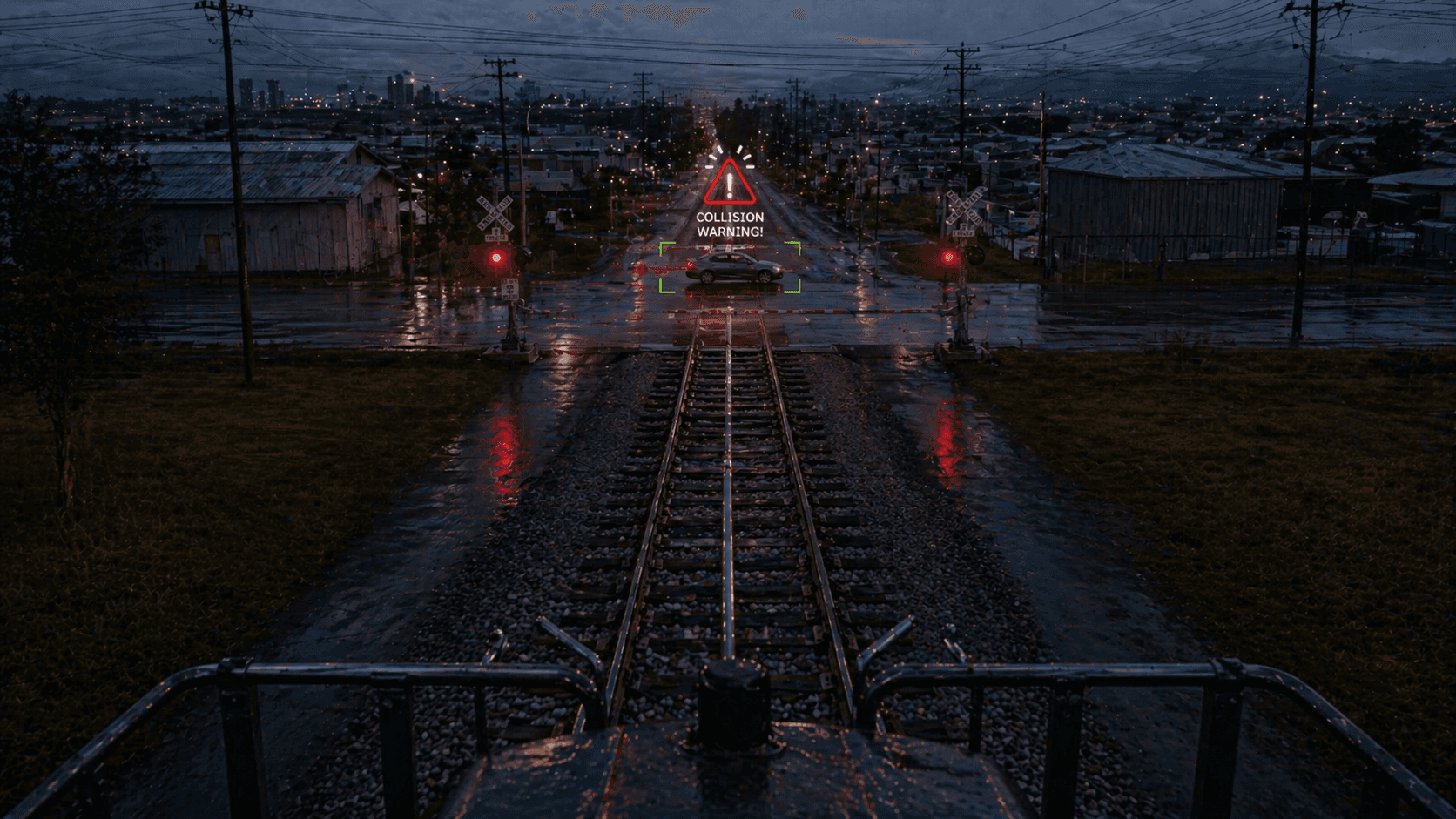
Object detected at 600 meters -- GuardView identifies an obstruction on the railroad track in real time.
The GuardView 3D Processing Pipeline
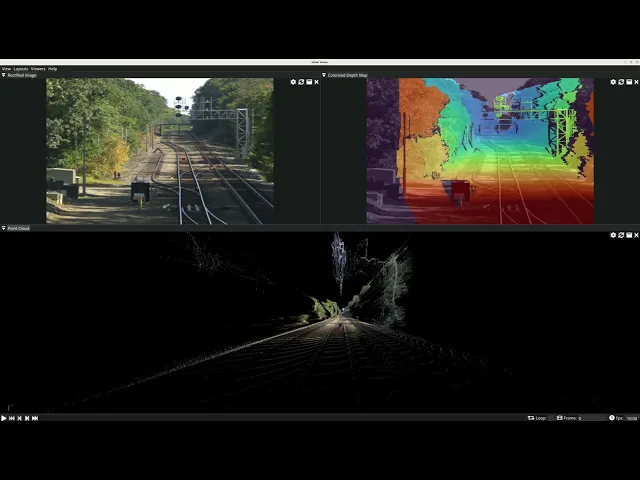
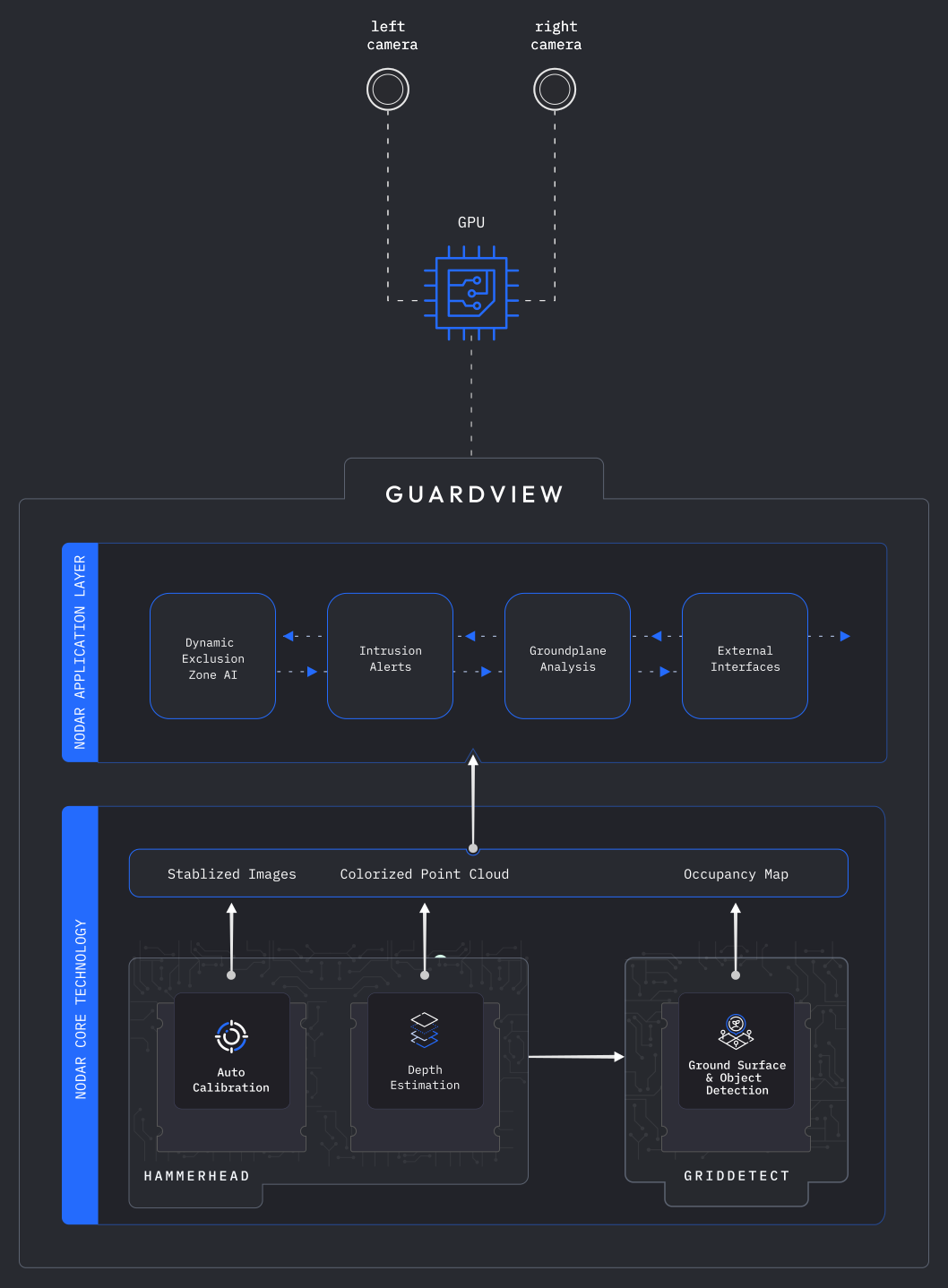
GuardView processes every frame through a complete four-stage pipeline, turning raw stereo imagery into actionable zone alerts in real time.
vibration resilience
Autocalibration
Patented per-frame algorithms correct stereo alignment continuously under vibration and thermal variation. No manual recalibration is required during operation, maintaining accuracy through continuous shock and movement.
depth computation
Stereo matching
Dense disparity maps generate a complete high-resolution 3D point cloud of the monitored area on every frame, at up to 50 million depth points per second.
Objest detection
Intrusion Detection and Tracking
GPU-accelerated occupancy grid processing identifies objects, tracks their coordinates and movement vectors, and classifies free space versus occupied space in real time.
Output
Zone Evaluation and Alarm Output
GuardView evaluates detected objects against user-defined zones and exclusion regions, triggering configurable alarms or PLC outputs when thresholds are crossed.
GuardView Architecture
Built for Any Environment That Can't Afford a Blind Spot
GuardView can be deployed in aviation, rail, construction, mining, warehouse logistics, perimeter security, and smart city applications. Its zone-based alarm system and adverse weather performance make it suitable for any environment where personnel, equipment, or critical infrastructure require continuous 3D monitoring.

Rail Crossing & Trackside Hazard Detection
Long-range identification of obstacles, debris, and intrusions on or near railway tracks and crossings. Persistent object tracking with configurable alert thresholds for track operations.

Passenger Boarding Bridge Monitoring
360° 3D monitoring of obstructions and personnel around PBBs as they extend and retract. Detects hazards in the bridge travel path before contact occurs.
Worker and Equipment Safety
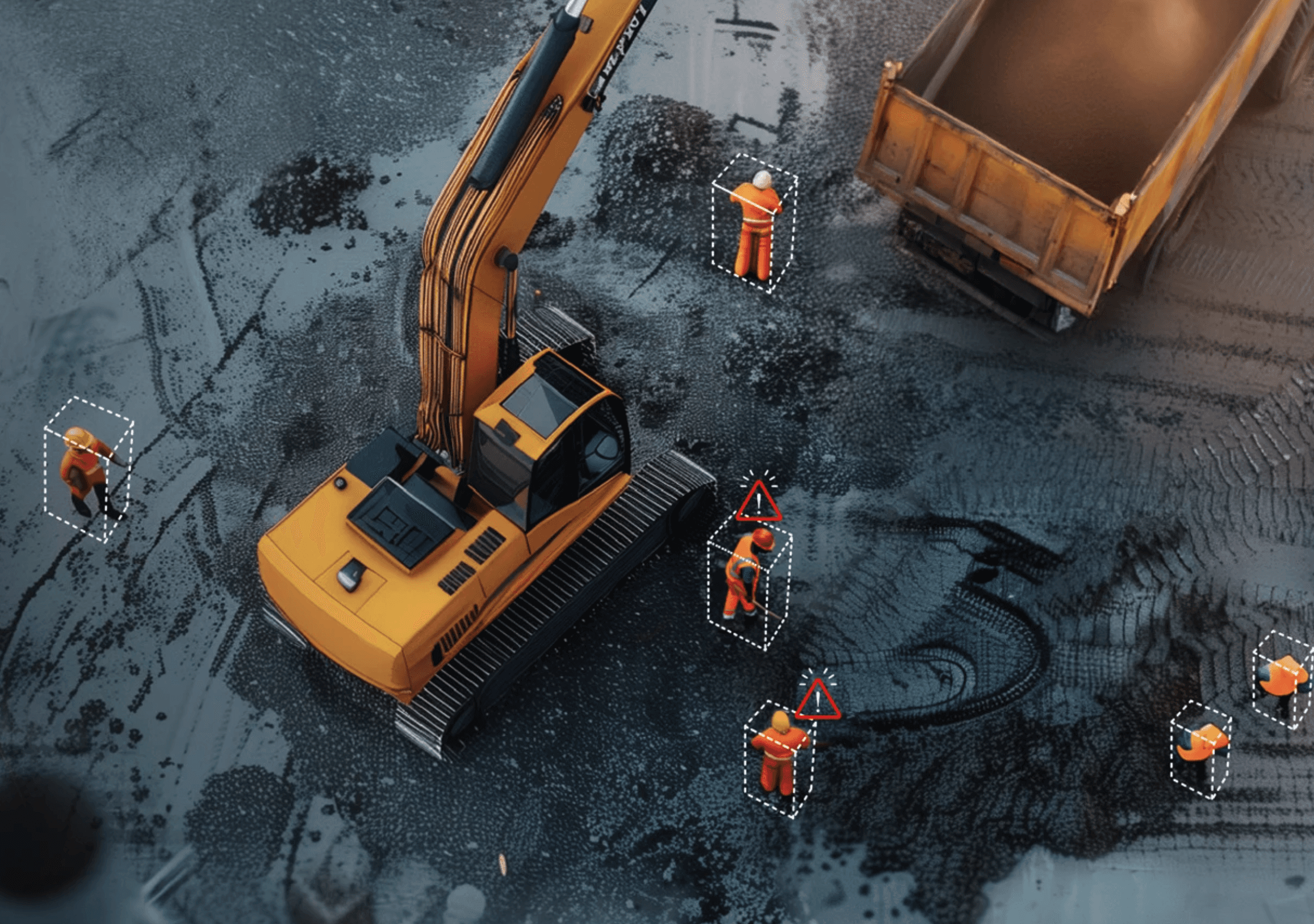
Monitors the movement of personnel and machinery across active construction sites, defining exclusion zones around heavy equipment and restricted areas.

Warehouse and Industrial Site
Monitors high-traffic indoor areas for unauthorized access, proximity to automated equipment, and unsafe conditions around loading zones or machinery.
Perimeter Security
Detects intrusions across the boundaries of critical infrastructure, commercial facilities, or secured perimeters. Zone-based alarms enable tiered response protocols.
Traffic and Smart City
Monitors intersections, access points, and high-footfall zones for congestion, incidents, and unauthorized access. Integrates with traffic management infrastructure.
Technical Specifications
System
Compute
Rugged NVIDIA Jetson Orin
Interface
ZMQ, ROS2, C++
Networking
10Gb Ethernet
Camera Interface
GSML2
Camera Sensor
Sony IMX728, 8MP HDR CMOS
Horizontal FOV
30°, 70°, 120° (custom on request)
Camera Alignment
±3° initial mounting tolerance
Supported Baseline
Up to 30 meters
IP Rating
IP67K (packaged solution)
performance
Detection Range
Up to 100 meters
Frames per second
25 fps (2MP), 10 fps (5MP), 6 fps (8MP)
Depth Points Per Second
Up to 50 million
Calibration
Continuous, every frame
Output format
Depth Map, Point Cloud, Bird's Eye View (BEV)
Output metrics
Color, Depth, Velocity
Sensor health
Per-pixel confidence map
GuardView Resources
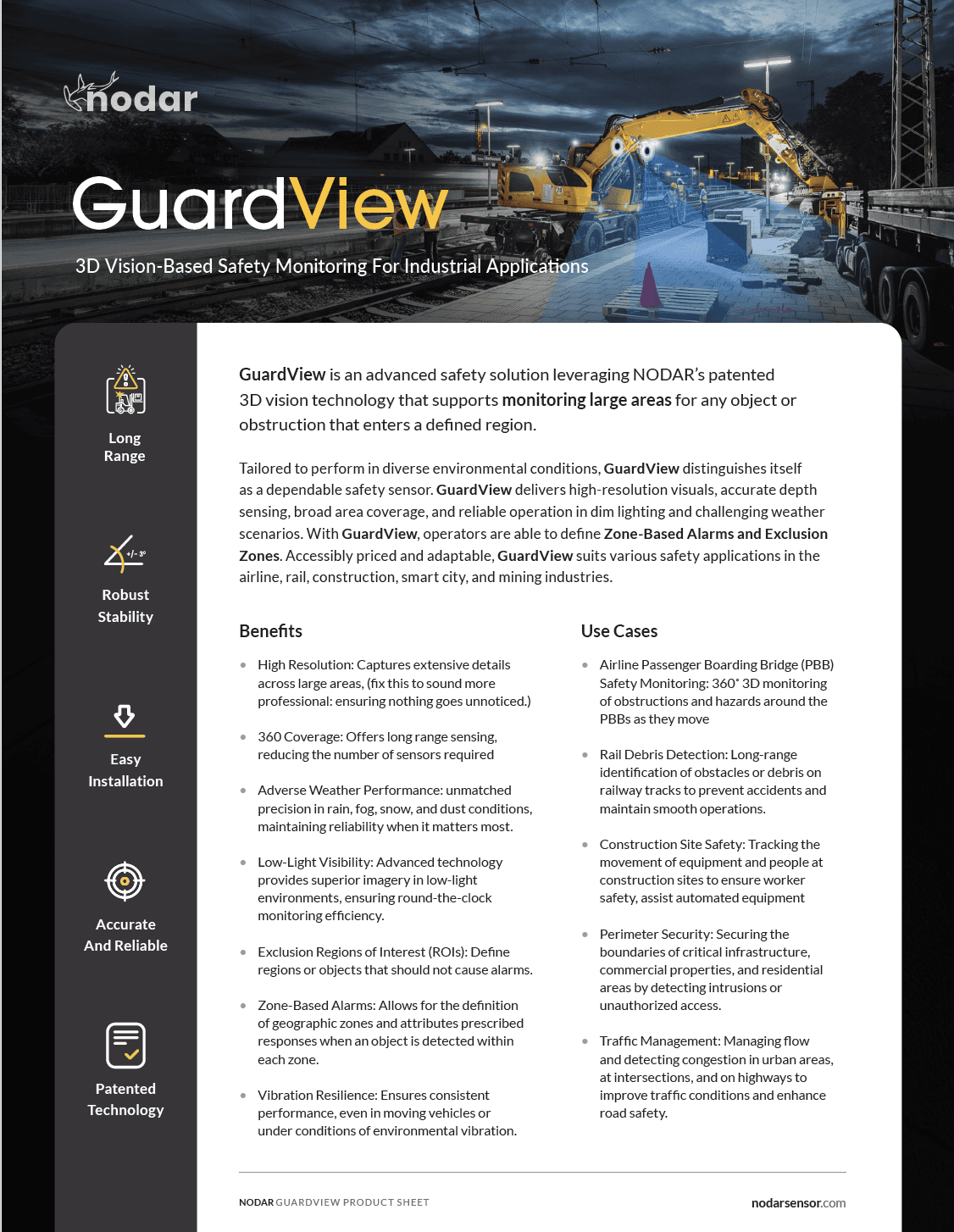
GuardView Solution Brief
An overview of NODAR GuardView covering key capabilities, technical specifications, and deployment use cases.