[ solutions ]
TerraView
High-resolution 3D sensing for autonomous and driver-assisted mining operations. Built on the NODAR Hammerhead platform, hardened for the harshest environments on earth.
Real-time 3D vision for extreme environments
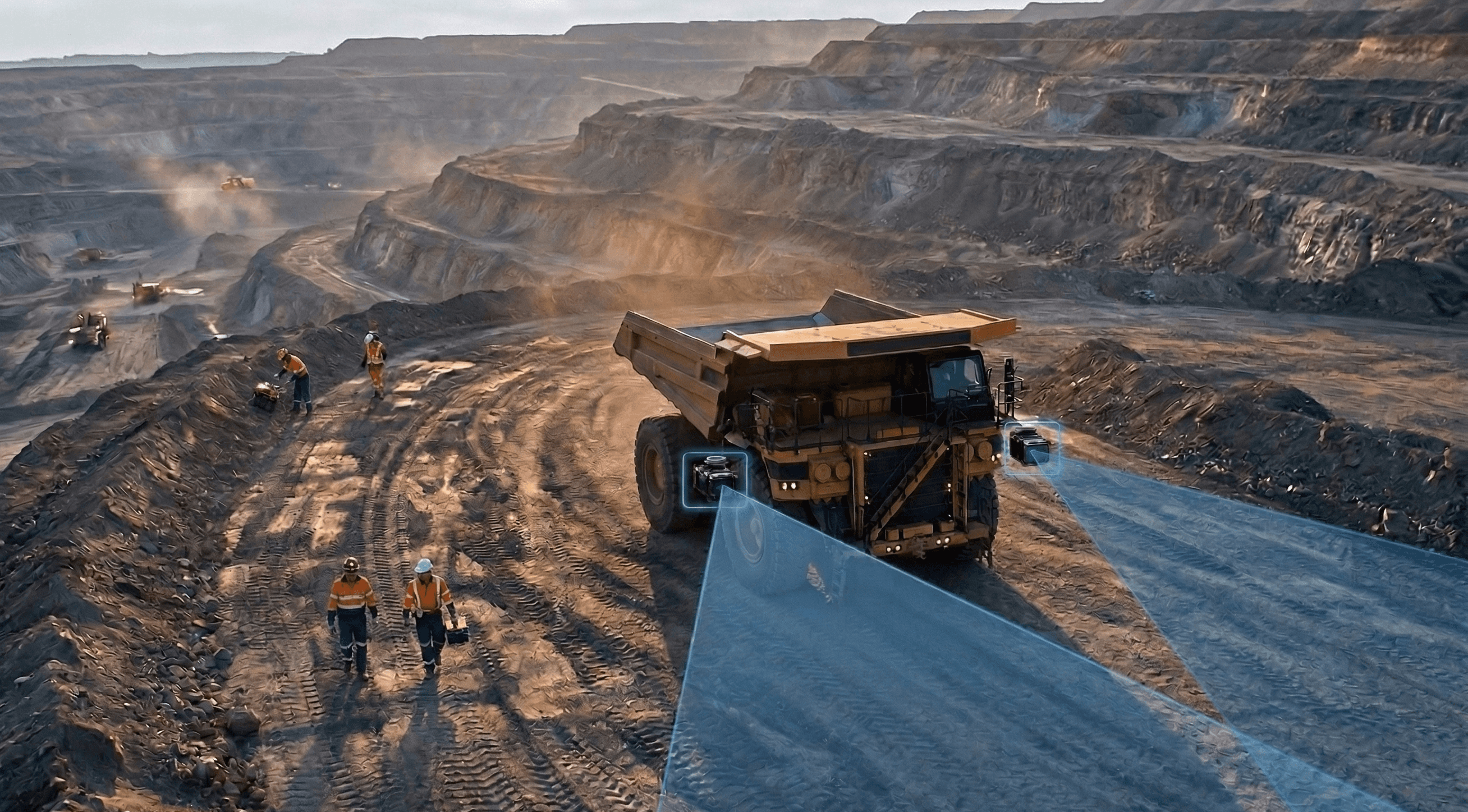
Autonomous mining operations demand 3D perception that works where other sensors fail: inside dense dust clouds, underground with no GPS, and on heavy equipment that shakes continuously. Standard sensors lose calibration, miss obstacles, and require frequent maintenance.
TerraView is a hardened, camera-based 3D perception platform built on NODAR's patented Hammerhead stereo vision technology. It delivers high-resolution depth and object detection at ranges up to 300 meters, with frame-by-frame autocalibration that holds accuracy through continuous vibration and shock -- above ground and below.
300m+
Detection Range
Dense 3D point cloud coverage
360°
Coverage Area
Full-surround sensing configuration
5cm
Accuracy at 30 m
High-precision depth at operational range
Engineered for the world's toughest conditions
Vibration-resilient calibration
Dynamic, frame-by-frame autocalibration corrects stereo alignment continuously under engine vibration and mechanical shock. No manual recalibration required.
Long-range obstacle detection
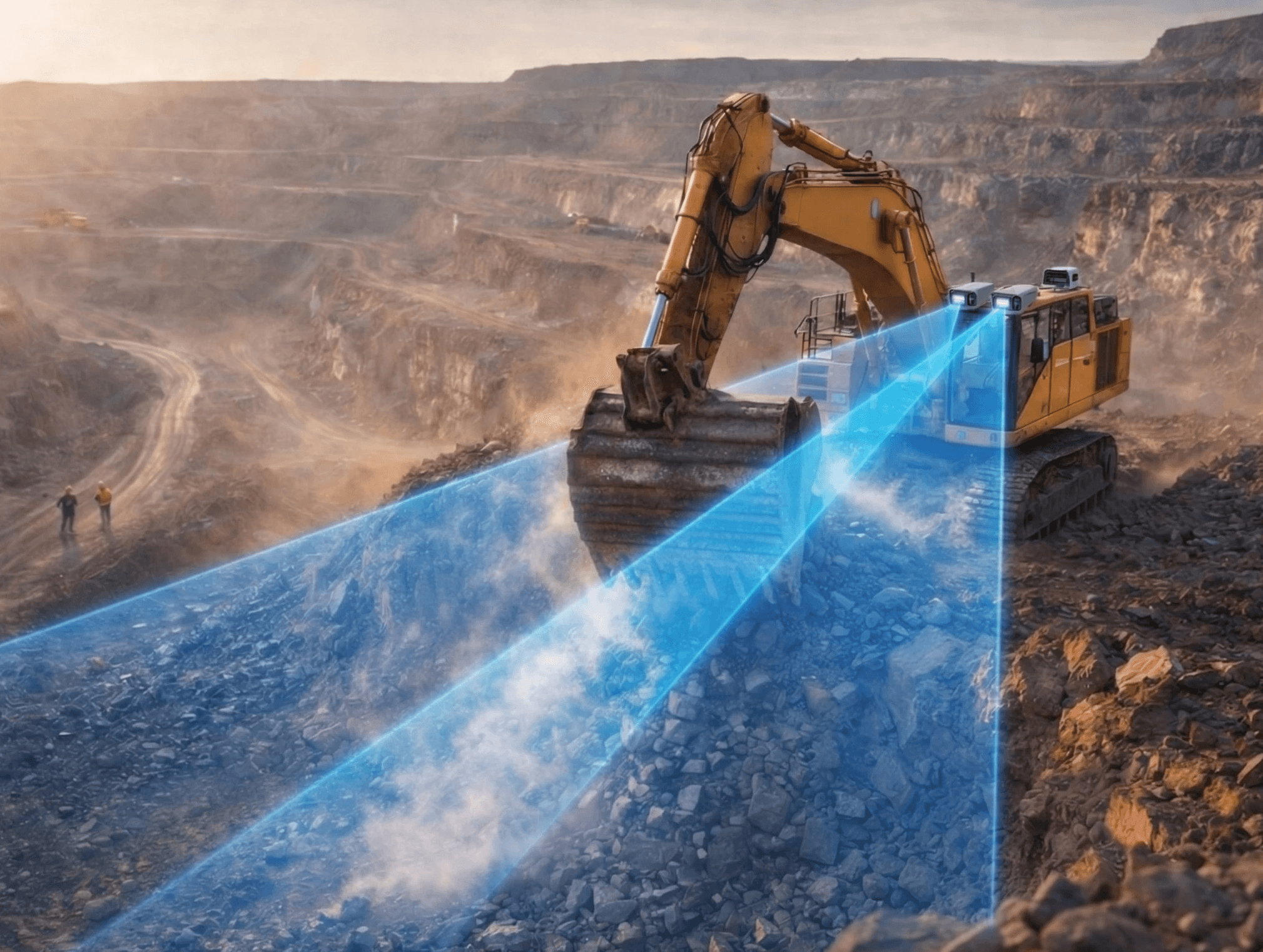
Dense 3D point clouds at ranges up to 300 meters detect people, vehicles, and debris well ahead of the equipment travel path.
360-degree coverage
Full-surround sensing configuration supports excavators, drillers, and haulage vehicles with no blind zones.
GPS-independent operation
Camera-based depth sensing requires no satellite signal, enabling reliable autonomy in underground and GPS-denied environments.
Hardened hardware
IP67-rated, solid-state design built for long-term deployment on heavy equipment with no moving parts to fail.
All-condition performance
Reliable in dust, heavy rain, low light, and high-temperature environments. Detects a 12cm object at 200m at 6.8 lux.
The TerraView processing pipeline
TerraView processes every frame through a complete pipeline, turning raw stereo imagery into actionable 3D perception in real time.
vibration resilience
Autocalibration
Patented per-frame algorithms correct stereo alignment continuously under vibration and thermal variation. No manual recalibration is required during operation, maintaining accuracy through continuous shock and movement.
depth computation
Stereo matching
Dense disparity maps computed at ranges up to 300 meters, generating a complete high-resolution 3D point cloud of the surrounding environment on every frame.
occupancy mapping
Obstacle detection
GPU-accelerated occupancy grid processing converts the point cloud into real-time free space and obstacle maps, tracking objects with coordinates and movement vectors.
Output
Complete dataset
Programmatic access to raw depth data, per-pixel per-frame confidence maps, and object lists with location and velocity. Delivered via ROS2, C++, or 10Gb Ethernet.
Depth Perception That Does Not Drift
Frame-by-frame autocalibration keeps TerraView accurate through continuous vibration, shock, and extreme temperatures -- no manual recalibration, no downtime.
From surface to underground
TerraView is purpose-built for the full range of mining operations, from open-pit haulage to GPS-denied underground environments.
Autonomous haulage
Reliable path planning and obstacle avoidance for autonomous trucks and loaders operating across open-pit sites.

Underground mining automation
3D sensing independent of GPS or LiDAR, purpose-built for confined, GPS-denied underground environments.
Collision avoidance
Detects people, vehicles, and site debris at long range, triggering warnings before equipment travel paths intersect.
Safety monitoring
360-degree 3D awareness around excavators and drillers reduces operator blind spots and supports remote monitoring.
Terrain mapping
Dense point clouds capture site topography and changing ground conditions for planning and situational awareness.

Occupancy tracking
Continuous object tracking with coordinates and movement vectors supports site-wide traffic management and safety enforcement.
Technical Specifications
System
Compute
NVIDIA GPU support
Interface
ROS2, C++
Networking
10Gb Ethernet or GSML2
Coverage area
Up to 360°
Alignment
+/- 3 deg
Baseline
Tested 10cm to 3m
Camera Resolution
0.5MP – 20MP
performance
Low light detection
12cm object at 200m @ 6.8 lux
Frames per second
Tested to 20fps
Accuracy
5cm at 30m (0.17%)
Calibration
Every frame on natural scenes
Output format
Depth Map, Point Cloud, BEV
Output metrics
Color, Depth, Velocity
Sensor health
Per-pixel confidence map