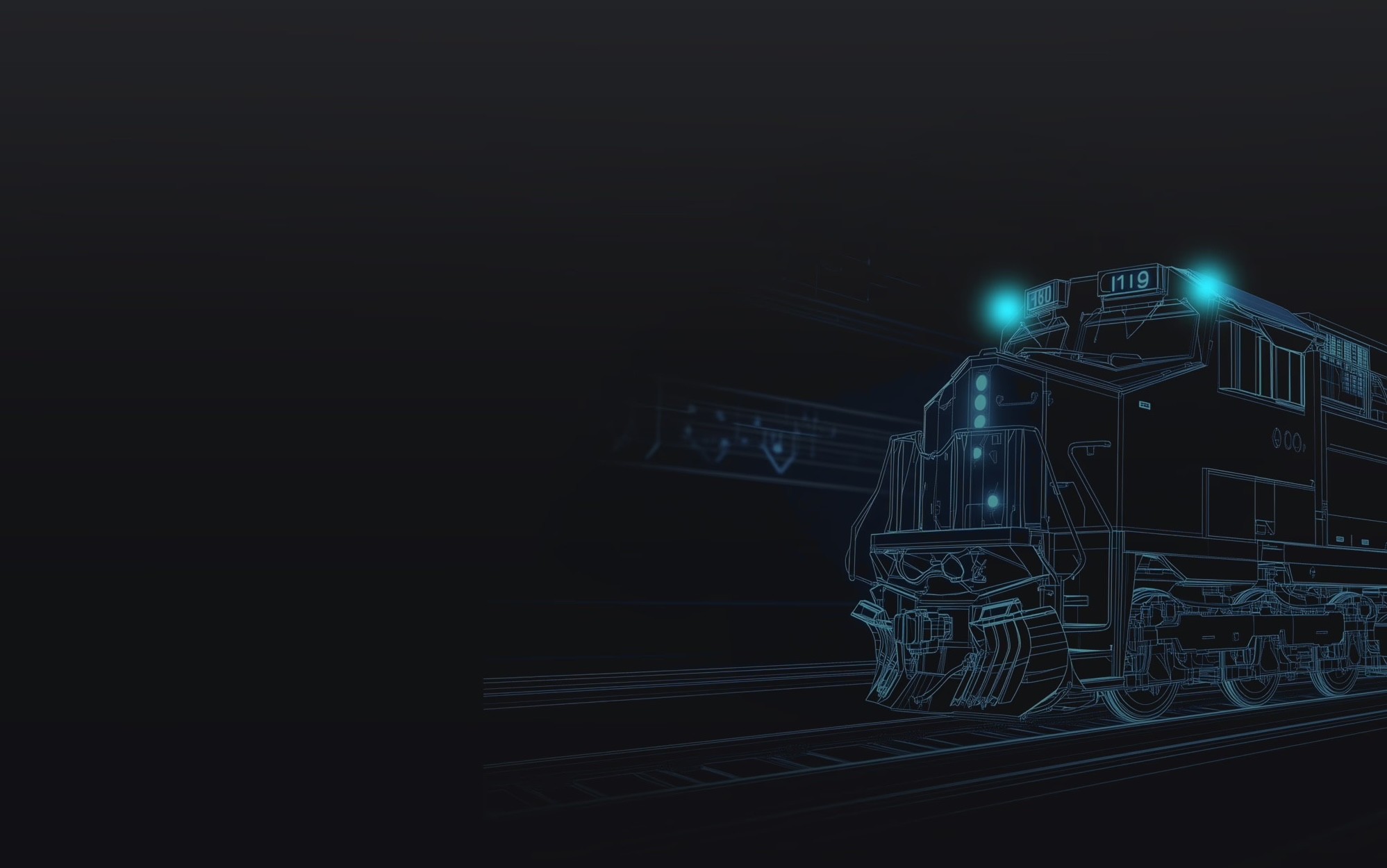
NODAR RailView is a collision warning system designed for the rail industry to prevent collisions with objects up to 1000 meters away. The system utilizes customized software built on our HDK (NDR-HDK-2.0-100-10-A). With its ultrawide-baseline stereo vision and 3D sensing capabilities, RailView can detect a wide range of objects—beyond just people and cars—such as random trash, rocks of various shapes, and debris.
Thanks to NODAR's advanced autocalibration algorithms, the ultrawide-baseline stereo camera always stays calibrated, even with platform shock and vibration. By measuring the three-dimensional structure of the area ahead of the train, the system can identify any physical object above the track surface, even if it encounters the object for the first time. For added reliability, we incorporate state-of-the-art AI detection methods.
System Architecture
Core System. HDK (NDR-HDK-2.0-100-10-A)
Computational module: industrial edge AI processing unit, Nvidia Orin AGX, fanless. 100-240 VAC, 50/60 Hz, 4A
Sensor module: Ultrawide-baseline stereo vision camera, 1-m baseline, 10-deg HFOV
(Add-on) Sensor module: Monocular thermal camera with state-of-the-art AI detector
Interfaces
(Add-on) Audio Alert System. USB-A to 3.5-mm audio adapter
(Add-on) Display module. HDMI interface
Navigation
(Add-on) Navigation module. USB GNSS module
Connectivity
(Add-on) 5G/LTE modem. 5G to Gigabit Ethernet Converter
Integration Hardware
Cables and interfacing equipment
(Custom) Hardware for mounting and cabling. We recommend attaching visible cameras to inside of windshield behind the wipers.
(Add-on) DC-DC converter. Specify input supply voltage: 110V for electric locomotive and 72V for diesel locomotive. Output supply voltage: 24V, 9.2A, 221W max.
RailView Resources
RailView Technical Specification
Full hardware and software specifications for the NODAR RailView collision warning system, including detection performance, environmental ratings, and integration interfaces.
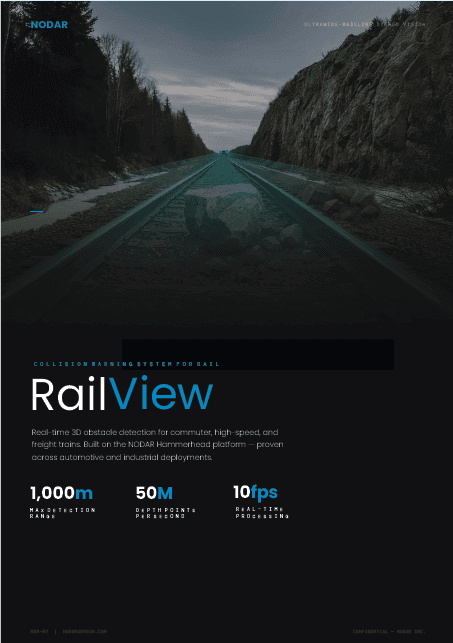
RailView Solution Brief
An overview of NODAR RailView — long-range 3D obstacle detection for rail — covering key capabilities, system architecture, and deployment options.
Specifications
Detection Range
Clear
<160 km/h
Horizon limited
1000 m (VIS)
Mild Fog
<160 km/h
300 m
300 m (VIS)
500 m (LWIR)
Dense Fog
<95 km/h
100 m
100 m (VIS)
250 m (LWIR)
False positives: <3 per 100km
False negatives = 0 (over testing to date)
Detection Range vs. Object Size
The minimum detectable object size vs. range for the 5.4MP HDR VIS camera and 10-deg HFOV lens.
Range
Min Object Size
500 m
0.4 m
800 m
0.8 m
1000 m
1.0 m
Additional Specifications
Recording: The current rugged embedded system has a 500 GB internal SSD. An external USB SSD can be attached. Assuming a capacity of 4 TB, the raw uncompressed 5.4mp 16-bit images from the two visible cameras (108 MB/s), can be stored for 10.3 hours at 5 FPS.
(Add-on) Compression module to allow storage of 15 days of compressed video.
(Add-on) Built-in self-test on power up, and give warning to the driver if the system fails and is not functioning as expected.
Power up time is less than 2 minutes.