

Precision was a tie.
Accuracy and close range were not.
We recently compared a popular off-the-shelf stereo camera (1 MP, 95 mm baseline, active IR) with a 5 MP binocular camera running our Hammerhead software. The 5 MP setup was about 4x more precise, as the optics predict for its longer focal length and baseline. The obvious follow-up question: what happens when you take away the resolution advantage?
So we ran the same humanoid robotics tests with a 1 MP binocular camera that costs $23. It has the same depth resolution as the reference camera at about 1/18 of the price.
The two setups
Reference stereo camera: 1280 x 720 depth map, 95 mm baseline, active IR stereo with a pattern projector, depth computed on board, $419, 116 g.
1 MP binocular + Hammerhead: 1280 x 720 depth map, passive stereo, depth computed on a host processor, $23, 20 g.

The 1 MP binocular camera running on a TI TDA4 evaluation board connected to a monitor showing the depth map and left image running at 25.9 FPS (later optimized to 27 FPS). Even with motion blur on the moving leg, the depth map reconstructs correctly.

The $23 1 MP binocular camera running Hammerhead, shown in the NODAR Viewer. Top: rectified left and right images. Bottom left: colorized depth map. Bottom right: the same scene as a 3D point cloud. The speckle board sits on a Pelican case.
No housing, no window
Ruggedized stereo cameras typically rely on a machined housing, optical windows, an internal stiffening cage, sealed connectors, and gaskets. Each adds cost and grams.
We tried a much simpler approach: applying a conformal coating over the bare $23 1 MP board. A housing's other job is to hold the two cameras rigidly aligned. Hammerhead's online calibration takes over that job, so the board doesn't need a stiff enclosure. The photo above shows it submerged in a glass of water with the cable attached.
Precision: comparable
We moved a speckle target board from 1 to 3 m, captured 20 frames at each distance, and computed the RMSE about the fitted plane. At 3 m, the $23 camera with Hammerhead measured 13 mm, and the reference camera measured 15 mm. With the same resolution on both sides, the optics predict similar results, and that is what we measured.

Depth precision vs. range, 1 to 3 m
Minimum range: the reference camera goes blind at 0.5 m
At 0.5 m, the reference camera returned no depth on the board. The $23 camera with Hammerhead produced a full, dense reconstruction. The minimum range is set by how wide a disparity range the matcher searches, and Hammerhead searches a wide range. We have tested it down to 0.1 m. For a humanoid looking at its own hands, that range matters.

Colorized point cloud with board with speckle pattern placed at 0.5 m. Reference camera (left) vs. 1 MP binocular + Hammerhead (right).
Accuracy: 4x better at 3 m
Precision tells you how noisy a surface is. Accuracy tells you whether it is in the right place. We measured the true distance to the board with a laser rangefinder. The reference camera's error grew steadily with range, and at 3 m Hammerhead on the $23 camera was 4x more accurate. In our earlier test, the same reference camera model read 72 mm too far at 3 m and 250 mm too far at 6 m.

Depth accuracy vs. range, 1 to 3 m
Calibration is the hard part
Accuracy is mostly a calibration problem. A small angular error between the two cameras becomes a range bias that grows with the square of the distance. Robots vibrate, get bumped, warm up, and fall a lot. What you calibrated on the bench slowly stops being true, and lightweight, slightly flexible structures make it worse.
Hammerhead recalibrates continuously from the live images. In an earlier test, the cameras started misaligned, and the Pelican case's depth map was unusable. By the second frame, the alignment corrected, and the case's shape returned.

Frame 1 vs. frame 2
Without that correction, the errors show up downstream as SLAM drift, phantom obstacles, and missed grasps.
$103 for complete depth
Passive stereo needs a processor to compute depth, and the usual assumption is that this means a large GPU and a matching power budget. That used to be true.
We ran the 1 MP tests with Hammerhead on both an NVIDIA Orin and a TI TDA4. The TDA4 costs about $80 at production volume. Add the $23 camera, and you have complete stereo depth for about $103 of hardware. Hammerhead also runs on NXP's Arm-based processors, so it fits on the kind of embedded silicon that is already inside many robots and vehicles.
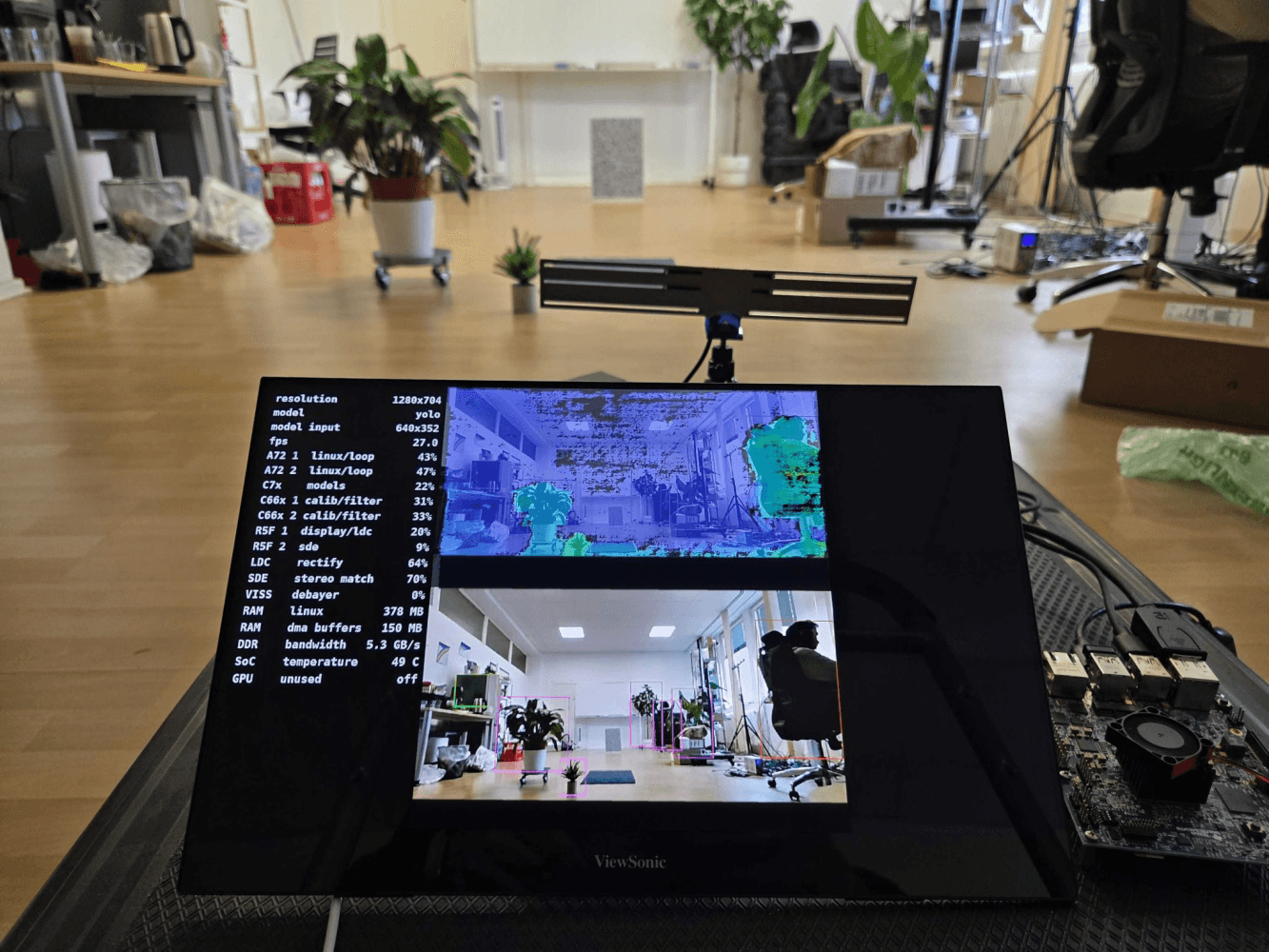
27 FPS of dense stereo depth plus YOLO detection on one TI TDA4VM, with the AI accelerator at 22% load. Stereo runs on dedicated hardware: rectification on the LDC at 64% and matching on the SDE at 70%. Hammerhead’s calibration and filtering use about a third of each C66x DSP. YOLO takes 22% of the C7x, the A72 cores sit under 50%, and the GPU is off. That leaves real room for the application layer: more models on the C7x, about half of each A72 for tracking and control, and an untouched GPU.
This test was for a humanoid, where the cameras sit on the head. On an inverted pendulum, mass at the top costs more than its weight: our rough estimate is that each gram on the head acts like about 4 g of dynamic load on the joints below. Going from 116 g to 20 g is not the headline, but the team cared about it.
Where the reference camera still wins
In fairness, the 1 MP reference stereo camera does some things better:
Its IR projector lets it work in the dark and on blank, textureless surfaces. Passive stereo needs some light and some texture.
It computes depth on board, so you don't need a host processor. The binocular camera needs one, even if it is small. Our $23 figure is camera hardware only, and Hammerhead is licensed separately.
For work in complete darkness or on blank walls, it remains a solid default.
Takeaway
At the same resolution, a $23 binocular camera with Hammerhead matched the reference camera on precision, beat it 4x on accuracy at 3 m, and kept seeing at 0.5 m where the reference camera went blind. It weighs 20 g, and a conformal coating makes it weatherproof and lets it survive submersion without a housing. Optics set the precision. Calibration sets the accuracy, and that is the part Hammerhead handles. If you are working through this trade-off on your own robot, I'm happy to compare notes.
Acknowledgements
This work was a team effort. Matthew Hölzel brought Hammerhead up on the TI TDA4 and optimized it to 27 FPS. Sabyasachi Paul built the 1 MP binocular camera rig and ran the precision, accuracy, and minimum-range tests.